
Joy in God’s Presence

Two-minute read.

As I turn my thoughts to the path of life, I grieve the loss of my beloved cousin Harry, who passed late last night at the age of 76. A robust man, he lived life to the fullest. His quick wit and dry sense of humor kept me on my toes. Any baby that came within arm’s length of Harry got balanced on their tippy toes in his mighty hands. Harry helped me learn how to live life, one day at a time, with a quiet strength.

I asked Harry, years ago at a family funeral, “How do you handle death well?”

“You learn to accept it’s a part of life,” he told me.

I’ve never forgotten that conversation. And as I think of Harry now, in the full glory of the Lord, He has learned the secret I have yet to learn. Without death, we don’t truly have life. One day, we will experience the glory that Harry now knows, the eternal pleasures at God’s right hand.

On earth, we can live in the joy of the Lord when we center our lives around Him. When days of loss come, we must seek God more deeply, trusting Him with what we do not know. As we die to self and pick up the cross that lies before us, we will experience the Lord’s joy as He grows and molds us to become more like Jesus.

David, the author of today’s psalm, didn’t find the life path; he received it, and in so doing found the joy of the Lord. As Christ’s followers, we don’t earn eternal life; we receive it through faith, as I did, as Harry did, as you do.

Harry has finished his work on earth; he will now bask in the Lord’s glory for eternity. For us that remain, the Lord still has divine work for us to do, a mission to complete and purpose to fulfill. And one day, when we finish our work, the Lord will call us home, and we will join the saints who went before us.

Until we meet again, Harry, I love you.

Reflection:

When sorrow comes your way, how can you lean into the Lord’s divine joy?

Joy Thought:

God’s joy walks with us through sorrow.

Joy Comes from the Lord

Two-minute read.

After returning from exile, the Israelites heard God’s Word read aloud for the first time in a long while. Culturally, the people stood for the reading while the leaders sat. Nehemiah read what we now know as the Old Testament to the people, chapter after chapter. As the crowd listened, they wept with deep conviction over how far they had drifted. But Nehemiah did not leave them in sorrow; with twelve words, he shifted the atmosphere.

Conviction awakens us to our need for salvation. The Lord desires restoration, not condemnation. The Israelites wept with conviction, surrendering their will to God. When Nehemiah spoke of the “joy of the Lord,” he referred to joy that comes from the Creator—joy not dependent on circumstances, but rooted in God’s presence in our lives. Even when we do not understand, the Lord continues to work on our behalf. Our joy flows from a relationship with Him, regardless of our understanding of it.

When we carry a settled confidence in God and His work in our lives, we discover His joy, and that joy becomes our strength. Nothing we do can manufacture it—not our performance, nor our ability to fix everything. The joy we receive from the Lord steadies our hearts, renews our energy, and gives us the courage to keep going.

Nehemiah instructed the people to eat, drink, and share with others. God calls us to live out joy, not just feel it. Conviction may bring tears, but the Lord never leaves us there. He invites us into a joy that restores, strengthens, and carries us forward—not shallow happiness or denial of pain, but a deep, anchored joy that says:

God remains here, and that changes everything.

Joy Thought:

God gives us His joy as a companion to walk with in life.

Reflection:

When conviction brings awareness of where you’ve drifted, how can you intentionally step into the Lord’s joy and allow it to strengthen you instead of remaining in guilt?

Kept By His Power

Two-minute read.

Jude grew up with Jesus, a half-brother to the Savior. At first, Jude didn’t believe. I can’t say I blame him. If one of my brothers made the claim, I’d have a hard time believing it as well. However, after Christ rose from the dead, Jude believed. When Jude wrote this letter, he didn’t introduce himself as “brother of Jesus,” instead, he chose “servant of Jesus Christ.” His words speak volumes about his faith.

In Jude’s short letter, he warns believers about false teachers, spiritual deception, and the importance of standing firm in the faith. From former skeptic to transformed believer, Jude has a bold voice for the truth. Take heart, you never know when meeting Jesus will change someone’s heart from doubt to devotion.

As Jude closes his letter, He does so with an assurance: God is able. Whatever trials we have before us, whatever rocks we stumble over, the Lord will keep us standing. He will help us persevere, not on our strength, but His.

God sustains us.

And He leads us.

We have a destination, and the Lord will make sure we get there. When we stand before the Savior on judgment day, we will do so without fault. We need not feel shame or condemnation because Christ saved us from our sin. The heavenly Father welcomes us into His glory with open arms, celebrating our arrival.

Salvation belongs to God alone.

Glorifying the Lord, we will rejoice in His splendor. The king above all, His power rules the world. Every part of God’s character deserves praise. God’s sovereignty existed before time. He has never lost control, and He will always be forevermore.

Jesus made eternity possible for us.

Our heavenly home awaits us.

But until then, the Lord will sustain us. He will direct our paths and straighten them. In Him, we have all we need to find victory. God holds us in His grip, and He won’t let go. We can trust in Him.

We don’t have to hold our lives perfectly together. God is able. He will complete His work in our lives, carrying us all the way home. Rest in the arms of the Savior. Wait with active trust, knowing God’s work will unfold, one day at a time.

The Lord bends to hear your prayers. He answers in His perfect way. And He loves you more than you can imagine. God holds you in His hand, and He won’t let go.

Journal Questions:

How does God sustain you?

Where has God led you so far?

End with praise. Write your own doxology.

Application:

Close this journey with praise and surrender.

This is the Day

Two-minute read.

Every day, God does it.

The Lord causes the sun to rise and set, the earth to rotate on its axis, and gives us breath in our lungs. A song of thanksgiving, celebrating victory that only God can accomplish, His work makes the way for us.

And we take it for granted.

We assume the sun will rise, the earth will rotate, and we will breathe. But every day, God does His work, and life continues. Today, this very day, God did it. Not yesterday or some day in the future, the Lord did it today.

Look around you, and take a moment to see God’s immediate work. We see it in the rays of sunshine and the twinkling stars. Any life you see moving around you, they move because of the Lord’s work. Electricity flows because the Almighty deems it so. Life itself, in all its forms, happens because of the Creator’s work.

We have many reasons to praise God.

And we have many reasons to rejoice.

Our joyous response doesn’t come from the day’s difficulties or victories, but in a singular truth: God’s working. We choose joy, even if we don’t fully understand. The Lord’s thoughts don’t match ours, and we won’t have all the answers on earth. But we can still choose to practice gratitude and celebrate God’s faithfulness.

On ordinary days, we can find reasons to rejoice.

On hard days, we can find reasons to rejoice.

God works, no matter what kind of day we have.

Today, rejoice in the victories that God has done for you, as well as in what will come. The Lord’s plan continues to unfold, whether we understand it or not. Each day draws us closer to eternal glory, and when the Lord calls us home, it will be our ultimate victory.

Take time to thank the Lord for one thing, then another. As you focus your eyes on the Savior, ask Him to change your heart. Seek divine insight into your struggles, and allow God space to work. Know, the Lord does work all things to the good for those who believe and trust in Him. And remember, the Creator never stops working.

God did it today. He gave us life. As we move through our days, look for the Lord’s work and join Him in it. Rejoice in His presence, trust in His will, and live in His joy.

Journal Questions:

Where do you see God working around you?

In what area do you not understand God’s work?

Declare today as God’s gift.

Application:

Choose joy deliberately.

Believe and See

Two-minute read.

“You must believe before you will see,” the pastor said on a balmy February morning in Naples, Florida.

While on vacation, we visited his church. As he stepped onto the stage, he prayed for healing over the congregation.

“Now, when you walk out those doors, you may not feel different,” he said, scanning the large auditorium, his hand extended toward the crowd. “You may have doubts. That’s when you remind yourself—God is still working. Healing will come.”

As I left the service, I felt unsettled. Part of his message bordered on what some call the prosperity gospel—the idea that God primarily wants to make believers materially wealthy and physically healthy. Scripture doesn’t support that. Jesus Himself said we would have trouble in this world (John 16:33).

And yet… he did speak truth about healing.

We may not experience complete healing on this side of heaven, but we will experience it when the Lord calls us home and we live in His glory. Healing will come—in God’s timing and in God’s way.

When Jesus spoke these words in John 11:40, He stood before Martha, who grieved the loss of her brother, Lazarus. Christ didn’t rebuke her. Instead, He gently reminded her that she could trust Him—even in the middle of loss, before she saw the outcome.

Jesus refers to the “glory” visible in the power and work of God. In just a few moments, Martha would witness what she could not yet see.

But first—she had to believe.

Then she would see the miracle.

Lazarus, raised from the dead.

Jesus teaches us something profound in this moment: belief often comes before breakthrough. We don’t believe because we see—we see because we believe.

And notice this—Jesus didn’t rush Martha past her grief. He met her in it, and then invited her to trust Him anyway.

Faith grows in moments such as this.

Right now, I’m walking through a situation that has left me disappointed and hurt. As I process it, I’m choosing to trust Jesus. I don’t understand why it happened or what purpose it serves—but I trust that God does. And I trust that He will use it for good for those who love Him and place their faith in Him.

What I cannot see, the Savior can.

Martha couldn’t imagine Lazarus breathing again. Her humanity couldn’t process it. But God knew—and He invited her to trust Him anyway. And when she did, she witnessed a miracle.

Without hard days, we wouldn’t recognize the good ones. Without hardship, we wouldn’t long for miracles. And without belief, we may miss God’s work.

So believe—even before you see.

Journal Questions:

Where do I need to believe to see God’s glory?

Describe a time you believed before you saw.

What miracle do you want to see happen today?

Application:

Expect God’s glory in small ways today.

Imitate the Faithful

Two-minute read.

Writing to a weary audience, the author of Hebrews addresses believers experiencing spiritual sluggishness—a drifting, a dullness in faith. This slow fade often comes when discouragement sets in, and perseverance feels too costly. Laziness here doesn’t refer to physical rest but to spiritual weariness that makes us pull back.

At some point, everyone will experience seasons like this.

God offers a clear response: imitate those who have gone before us and experienced spiritual victory. The Lord created us for community; He never meant us to walk this life alone. When we surround ourselves with people whose lives reflect steady trust in the Savior, we learn how to persevere when we feel like giving up.

In Hebrews 11, the author highlights men and women who lived by faith—Abraham, Noah, Sarah, Isaac, Joseph, and many others. They all had problems and faced hardship. Yet they clung to God’s promises and kept going. Eventually, they received the promise either in this life or in eternity. Their stories strengthen us to endure.

I saw this kind of faith lived out in a deeply personal way. When robbers took the life of my friend and shot his father—my pastor—leaving him for dead, it devastated me. I wondered how he would respond to such a tragedy. But when he awoke from his coma, he requested his Bible and books on heaven.

In that moment, something in me shifted.

His lifelong relationship with the Savior sustained him through unimaginable loss—and still does. Like the patriarchs, he chose to trust God even when he did not understand. The Lord didn’t answer all our questions, but He carried us through the darkest days.

Hebrews reminds us that perseverance requires both faith and patience. Faith trusts God’s promises, even when we don’t see immediate results. Patience endures while we wait for those promises to unfold. Faith believes. Patience waits. Together, they form a steady, resilient walk with the Lord.

God’s promises unfold over time. Some we experience here—His peace, His presence, His provision. Others we won’t fully realize until He calls us home. But in every case, His Word proves true.

God never promised quick results. Faith in Christ builds through consistency over time. He doesn’t reveal His promises through fleeting bursts of passion, but through steady, patient endurance.

We don’t have to sprint to the finish line.

We have to keep going—steady and faithful.

One step at a time, we will see the fulfillment of God’s promises as we continue to follow Him.

Journal Questions:

Who models patient faith for you?

What would it look like to imitate them this week?

Where are you tempted to grow weary or “check out” spiritually?

Application:

Learn from someone who models steady trust.

Every Promise is a Yes

Two-minute read.

Jesus fulfilled every promise God has ever made.

From the earliest covenants to the hope of redemption, the Lord has always kept His word. Every promise reflects His character—unchanging, trustworthy, and true. And He fulfilled them by sending His Son to live and die for us. When the Savior walked out of the tomb, He confirmed the reality of the Father’s mercy, the availability of forgiveness, the nearness of God’s presence, and secured our salvation.

Everything the Lord said He would do—He has done, and continues to do.

Humanity failed in its attempts to keep the law, but Christ succeeded. Born of a woman, Jesus lived a sinless life. Then He took our sin to the cross, accomplishing what we could never do for ourselves. In Him, God answered every promise with a resounding “Yes,” making us the beneficiaries of His finished work.

“Amen” means “so be it” or “it is true.” When we say it, we express trust, agreement, and worship. We declare that we believe God will do what He says. Our “Amen” becomes our participation in His will, echoing what He has already spoken.

Ultimately, God’s faithfulness brings Him glory. As we live trusting His promises, our lives point others to Him. Our faith becomes testimony.

In Philippians 4:19, Paul reminds us that God will meet all our needs according to the riches of His glory in Christ Jesus. One of my favorite promises—I lean into it daily. Jesus has already met my greatest need by conquering sin, and He continues to provide for my physical, emotional, and spiritual needs. He nourishes me through His Word and sustains me in every season. Everything I truly need, Christ provides.

Needs and wants differ.

God never promised to give us everything we want, but He does promise to provide what we need. And our greatest need—reconciliation with the Father—He fulfilled through Jesus.

When God says He will do something, He does it. We don’t have to question His faithfulness; He has proven it time and time again. His Word stands the test of time—reliable, enduring, and unfailing.

Praise Jesus for fulfilling every promise of God.

Lean into the Savior and discover that in Him, you already have everything you need—not just for today, but for eternity.

Journal Questions:

What promises of God speak directly to my prayer?

Where do you find yourself questioning God’s promises right now?

What would it look like to replace uncertainty with a quiet, confident “Amen”?

Application:

Claim one promise of God personally.

Peace That Guards

Two-minute read.

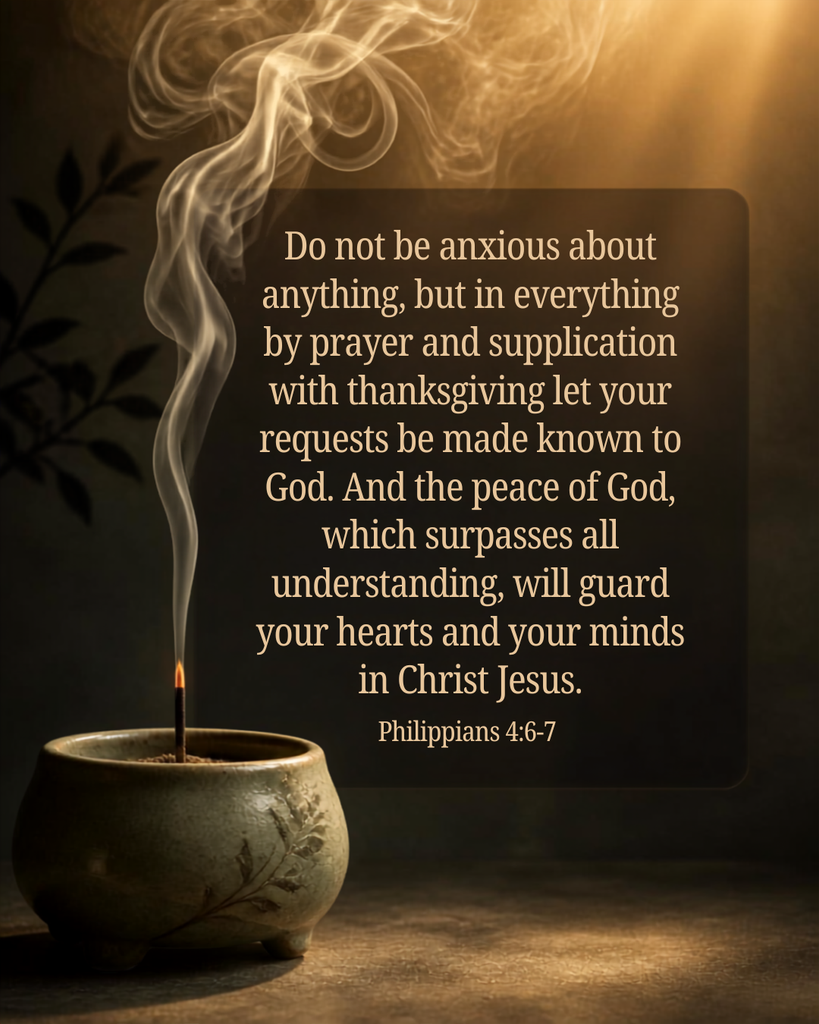
While in prison, Paul writes these words to the Philippians. Chained to a guard, the apostle instructs us, “Do not be anxious about anything.”

Can you imagine?

Paul doesn’t offer this encouragement from a stress-free life, but from one marked by hardship. He doesn’t deny real concerns; he redirects them. Anxiety often comes from carrying what God never intended us to carry alone.

In a world where we have everything at our fingertips, people suffer from anxiety more than ever. Studies from the Centers for Disease Control and Prevention, the National Alliance on Mental Illness, and the American Psychiatric Association report that 1 in 5 adults struggles with anxiety—and the number continues to rise year after year. Anxiety has become one of the most common mental health challenges in the United States.

And yet, a prisoner in Rome around AD 60–62, chained to a guard, offers a powerful response to this growing struggle: pray with thanksgiving, and we will experience the peace of God. A peace that guards our hearts and our minds.

When anxiety begins to rise in me, I try to use it as a reminder to pray.

For example, I often have to drive across the 4.5-mile-long James River Bridge, which spans an active shipping channel. Because of the military vessels that pass beneath it, the bridge has a steep incline that makes my stomach drop as I begin the climb. As my tires roll over the metal grate where the bridge opens, the car shifts slightly. Uninvited thoughts creep in, and anxiety starts to build.

So I call on the Lord and place my anxiety in His hands.

First, I thank Him—for His provision, for my car, for the bridge, and for the ability to drive. Then I ask Him to take my anxiety and replace it with His peace.

And something begins to shift.

Instead of focusing on the steep rise ahead of me, I start to notice the beauty around me. The view from the bridge stretches wide—the water below, the shoreline in the distance. At sunrise or sunset, the sky puts on a display that can take your breath away.

By redirecting my thoughts, just as Paul encourages, I begin to experience the Lord’s peace overcoming my anxiety. Each time I lean into the Savior, I find myself trusting Him more—trusting Him to guard my heart and mind.

I ask God to quiet the enemy’s whispers and help me fix my eyes on Him.

Follow Paul’s invitation.

Lift your anxieties to the Savior.

Begin with gratitude.

Bring Him your fears.

Ask for His help.

And trust Him to do the rest.

Journal Questions:

How do you identify anxiety?

What anxiety must I release?

How can you make Paul’s instructions a part of your life?

Application:

Exchange anxiety for written gratitude.

Rejoice Now

Two-minute read.

Three commands that roll off the tongue easily, yet stretch us in the best way. When we put them into practice, they keep us in constant connection with the Lord, leading to abundant living—regardless of our circumstances.

“Rejoice always” doesn’t mean celebrating the hard things we endure. Nehemiah 8:10 reminds us that “the joy of the Lord is our strength.” God’s servant refers to a deep, sustaining joy that gives us strength, carries us through sorrow, restores our hearts, and enables us to keep going. Think of plugging your phone into a charger—through that connection, it receives the power it needs to keep going. In the same way, when we rejoice in the Lord’s presence—a God who never leaves or forsakes us—we receive a divine joy the world can’t understand.

“Pray continually” means keeping the charger plugged into the source. Today, we even carry portable chargers to stay connected on the go. As believers, we stay connected to the Savior by keeping the conversation going. Prayer often looks like short, simple phrases woven throughout the day:

Thank You.

Help me.

Guide me.

Show me.

Forgive me.

These small prayers keep God in the center of our everyday moments, helping us remain connected to the source of our joy and strength.

“Give thanks in all circumstances” flows from recognizing God’s presence in every situation. We trust His plans as they unfold—even when we don’t understand—and choose gratitude as an act of faith.

“For this is God’s will…”—not a mystery, but a posture. Through 1 Thessalonians 5:16-18, Paul the Apostle makes it clear: God wants us to live lives marked by joy, prayer, and gratitude—lives aligned with Him.

When we begin to see these three commands as a rhythm, something shifts. Our faith becomes steady and resilient:

Joy lifts our hearts

Prayer keeps us connected

Gratitude grounds us

Adopt a life of joy, prayer, and gratitude by practicing Paul’s words. Keep the Son in your eyes, and allow Him to fill your heart with songs of praise. Keep the connection strong, let the Lord charge your life with His power. Enjoy the divine gifts He longs to give you. With a song on your lips, you can face anything with boldness and courage, knowing the source of your strength.

Start today. Sing the song of joy, prayer, and gratitude. Live in the love of the Lord.

Journal Questions:

What can I thank God for before I see change?

How can you stay more connected to the source?

What prayers do you say throughout your day?

Application:

Thank God before you see results.

Watchman Hope

Two-minute read.

Pilgrims, on their way to worship, would sing the Songs of Ascents—a collection of psalms filled with hope and expectation. When they sang Psalm 130, they did so anticipating what the Lord would do, not waiting passively but with eager trust. With fully engaged hearts, minds, and spirits, they lifted their praise to God.

When we reach the end of our rope—when we exhaust our options and our answers fall short—we turn to the Lord for direction. Trusting the Savior means believing He knows what we do not. Step by step, we walk by faith, relying on God to do what we cannot do for ourselves.

“Now to him who is able to do immeasurably more than all we ask or imagine, according to his power that is at work within us, to him be glory in the church and in Christ Jesus throughout all generations, for ever and ever! Amen.”
— Ephesians 3:20-21

The apostle Paul echoes the psalmist’s heart in his letter to the Ephesians. Transformed by his encounter with Jesus, Paul understood that God’s power far exceeds anything we can imagine or dream. Like the psalmist, he lived with expectation—trusting God to move—and encouraged others to do the same. We, too, can wait with hearts full of hope, confident that God’s plans will surpass our expectations.

Watchmen stood guard through the night, scanning for danger. When the sun rose, it brought relief—safety, light, and rest. They never questioned whether morning would come; certain of it. In the same way, as followers of Jesus, we have nothing to fear and everything to anticipate. Anchored in God’s Word, we can wait with deep longing and steady confidence, trusting that He will fulfill every promise.

Sometimes, waiting feels like the longest night.

But we can trust the Son to rise—because He already has.

As we wait with expectant hearts, rooted in the Lord, we draw closer to Him. Jesus fills us with joy, and the hope of eternity fills the deepest places within us. In Christ, we learn to wait well, knowing His promises will unfold in perfect time.

So watch the sunrise as light breaks through the darkness. Let it remind you: in His time, God’s light will shine, and His promises will come to life in ways beyond what you can imagine. The Lord always keeps His word—you can trust Him.

Journal Questions:

How does knowing God keeps His word help you in the waiting?

How can you anchor yourself to God’s word more firmly?

Write a prayer of hopeful expectation.

Application:

End the day with hopeful expectation rather than worry.